Cow Ghee Diya: Price, Value and What You're Really Paying For
Part of this cluster. Also see: Cow Ghee Diya for Regional Festivals & Karthika Masam | Cow Ghee Diya Myths vs Facts | Cow Ghee Diya in Bulk: Buying Guide
A cow ghee diya doesn't look like it needs a pricing conversation — it's a small clay lamp with ghee and a wick. But once you start comparing packs online, the price per piece can range widely, and it's worth understanding what actually drives that number before you buy on price alone.
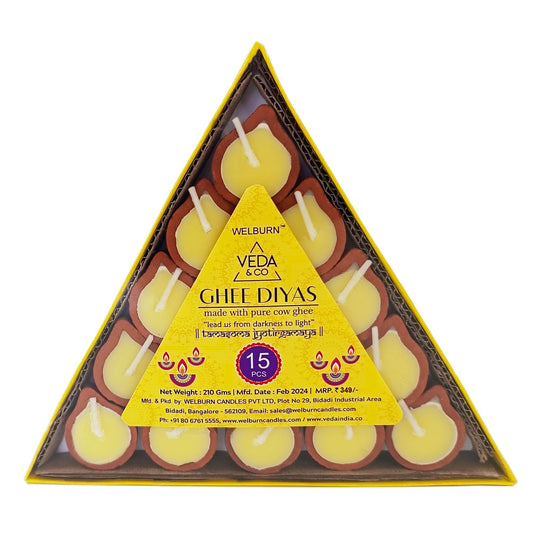
The three things that move the price are ghee quantity, wick quality, and burn time. A diya rated for 45 minutes uses noticeably less ghee than one rated for up to 3 hours, so comparing two packs purely by price per piece without checking burn time is comparing different products. Veda & Co's pack of 15 is built for a 50–55 minute daily burn, while the 7-piece pack rated up to 3 hours uses more ghee per diya and is priced accordingly.
Buying in bulk changes the math meaningfully. The pack of 30 and the pack of 60 both bring the effective cost per diya down compared to smaller packs, which matters if you light one daily rather than only during festivals. If you go through a diya most days for regular puja, working out cost per month rather than cost per pack gives you a more honest comparison.
It's also worth separating price from purity. A cheaper diya isn't automatically adulterated, and an expensive one isn't automatically pure cow ghee — the only reliable signals are a clear ingredient statement and a flame that burns steady and mostly smoke-free. Ghee itself is a clarified butter product with a long history in Indian cooking and ritual use, and quality varies by source regardless of what a label claims, so it's worth buying from a source that states its ingredients plainly rather than relying on the word 'pure' alone.
Buying Ghee Diyas in Bulk for Temples, Societies, and Events
For institutional buyers such as temples, housing society festival committees, community groups, and event organisers, buying ghee diyas involves different considerations than a typical household purchase.
Instead of planning around daily household use, bulk buyers need to consider the number of diyas required, event dates, burn duration, delivery timelines, and overall consistency.
1. Plan Your Order in Advance
For large events such as Diwali celebrations, temple utsavams, and society Navratri programmes, it's better to place bulk orders well ahead of the event.
As a general planning guideline, consider ordering 2–3 weeks in advance rather than waiting until the final 5–7 days. Larger orders may require additional time for processing, packing, and delivery.
This also gives you some buffer in case you need to adjust quantities before the event.
2. Keep Pack Sizes Consistent
If hundreds of diyas will be lit together — for example, in a temple hall or during a community pooja — using the same pack type across the event can make the setup more consistent.
Ordering multiples of the same pack size and diya format can help maintain similar burn characteristics and create a more uniform visual arrangement when many diyas are lit at once.
3. Contact Veda & Co for Larger Requirements
When your requirement goes beyond the standard quantities available online, contacting Veda & Co directly can be more practical than placing multiple individual orders.
For larger institutional requirements, a direct enquiry can help you discuss:
-
Required quantity
-
Bulk pricing
-
Available pack sizes
-
Production or preparation timelines
-
Delivery schedules
-
Event-specific requirements
This allows the order to be planned around the specific date and scale of your event rather than relying solely on standard online pack quantities.
Plan Your Bulk Diya Purchase Ahead
Whether you're organising a temple celebration, a housing society festival, or a large community event, planning your diya requirement early can make the process considerably smoother.
Estimate your total quantity, choose a consistent pack format, and contact Veda & Co in advance for larger orders to ensure your diyas are ready when the celebration begins.
If you're weighing whether the price is worth it against a plain oil lamp or a synthetic alternative, the honest answer is that a cow ghee diya costs more per burn — you're paying for the ghee, not just the wick and clay. Whether that premium is worth it comes down to whether the ritual, tradition, and flame quality matter enough to you to justify it, which is a personal call rather than a purely financial one.
Frequently Asked Questions
Why do cow ghee diya packs vary so much in price?
Ghee quantity, wick quality, and rated burn time all affect the price. A diya rated for 3 hours uses more ghee than one rated for 45 minutes, so the packs aren't directly comparable on price alone.
Is a bigger pack always better value?
Usually yes if you use a diya daily — larger packs like the 30-piece or 60-piece bring down the cost per diya. For occasional or festival-only use, a smaller pack may suit you better even at a slightly higher per-piece cost.
Does a higher price mean purer ghee?
Not necessarily. Price reflects ghee quantity and burn time as much as purity. Check the ingredient statement directly rather than assuming price is a purity signal.
How much does daily cow ghee diya use cost per month?
It depends on the pack size and burn time you choose — working out packs-per-month based on your daily habit gives a more accurate figure than comparing single-pack prices.