Smokeless Clay Ghee Diya: Why It's Better for Daily Puja at Home
The Urban Puja Problem: Smoke in Small Spaces
India's cities are full of devotees who have quietly stopped lighting diyas — not because they lost faith, but because the smoke in a small flat became impractical. The solution is a pure clay ghee diya. A correctly prepared, pure-ingredient clay ghee diya is nearly smokeless. Here's the science and the practice.
Why a Pure Clay Ghee Diya Produces Minimal Smoke
1. The Fuel: Pure Cow Ghee
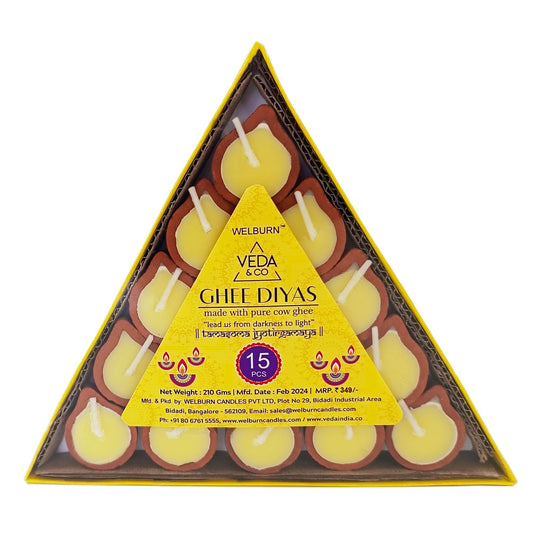
Pure cow ghee is composed of saturated fatty acids with very low moisture content. When burned, these combust cleanly. Smoke comes from incomplete combustion — and incomplete combustion is primarily caused by moisture, impurities, or adulteration in the fuel. This is why Veda & Co uses 100% pure cow ghee — no vanaspati, no vegetable blending, no wax.
2. The Wick: Unbleached Cotton
A synthetic or bleached wick introduces chemical combustion into the flame — visible as thin black smoke. Veda & Co uses unbleached, pure cotton wicks in every clay diya.
3. The Clay Cup
A natural clay cup doesn't off-gas or add impurities to the combustion, unlike plastic-base 'diyas' coated to look like clay.
Compared to What You Might Be Using
Paraffin candle vs clay ghee diya
Paraffin is a petroleum-derived wax. When burned, it releases benzene and toluene — compounds classified by the WHO as indoor air pollutants. A pure clay ghee diya produces none of these petrochemical byproducts.
How to Get a Smokeless Burn Every Time
- Use only pure cow ghee. Never mix with oil or vanaspati.
- Keep the wick trimmed to 5–7 mm above the ghee surface.
- Don't place the diya in a direct draft.
- For Veda & Co ready-to-use diyas, the wick is pre-set at the correct height.
- Ensure the ghee level is at least 1/3 full.
- Burn in a room with a slight crack of ventilation.
Conclusion
A smokeless clay ghee diya is the natural result of using the right ingredients in the right way. Pure cow ghee, pure cotton wick, natural clay, and correct placement. Shop Veda & Co's smokeless clay ghee diyas.
Frequently Asked Questions
|
Q1 |
Are clay ghee diyas actually smokeless? |
|
A |
Nearly smokeless — yes, when made with pure cow ghee and a cotton wick. The key is pure ingredients: adulterated ghee, synthetic wicks, or wax-blended diya bases are the primary sources of visible smoke. |
|
Q2 |
Why does my ghee diya produce black smoke sometimes? |
|
A |
Black smoke usually indicates: an overly long wick (trim to 5–7 mm), adulterated ghee, running very low on ghee, or a draft hitting the flame at an angle. |
|
Q3 |
Can I use a ghee diya in a closed room? |
|
A |
Yes, for a single diya during a standard puja (20–45 minutes), a slightly ventilated room is sufficient. Keep a window cracked or a door ajar to provide fresh air for combustion. |
|
Q4 |
Why is a clay ghee diya better than a scented wax candle for daily puja? |
|
A |
For puja specifically: a clay ghee diya is a Vedically prescribed sacred flame offering. Pure cow ghee produces no petrochemical combustion byproducts, while paraffin wax releases benzene and toluene. Full comparison guide. |
|
Q5 |
What makes Veda & Co ghee diyas different from other brands? |
|
A |
Three key differences: (1) 100% pure cow ghee , no vanaspati. (2) Handmade natural clay — no plastic base. (3) Unbleached cotton wicks. Shop here. |